Guide
LinkedIn Ad Library: How to Use It (and What It Can't Show You)
LinkedIn's Ad Library shows you every ad a company is running right now, free and without a login. That "right now" is the whole story: the moment a campaign stops, its ads are gone from the library, and with them any way to tell what a competitor actually ran or how long they kept paying for it. This guide covers how to use the tool properly, exactly where it stops, and what the same ads look like when somebody keeps the history.
What is the LinkedIn Ad Library?
The LinkedIn Ad Library is LinkedIn's public ad transparency tool. It lists the ads each advertiser is currently running on the platform, along with who paid for them and, where LinkedIn discloses it, the targeting parameters and rough impression ranges behind them. It is free, it needs no account, and it covers every advertiser on LinkedIn, not a curated selection.
It exists because ad transparency regulation requires it, and that origin explains its shape better than any feature list does. It was built to answer a regulator's question, "who is paying to say this, right now," not a marketer's question, "what works in my category." Everything it does well and everything it refuses to do follows from that one distinction.
How to use the LinkedIn Ad Library
There are five steps, and they take about a minute per company.
- 1
Open linkedin.com/ad-library
It's public. No LinkedIn account, no login, no ad account required.
- 2
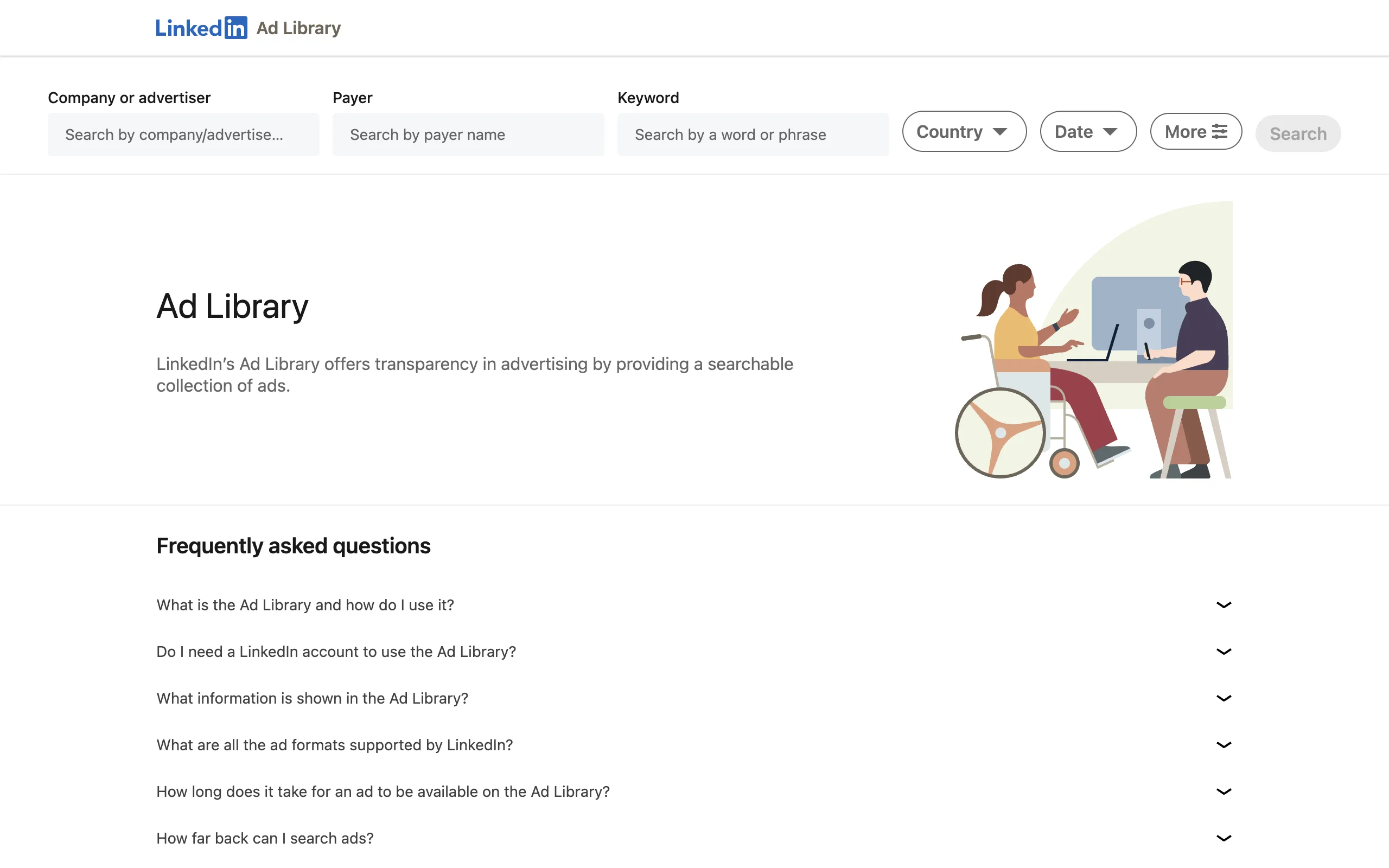
Search by company, payer or keyword
Three fields, and they all assume you already know what you're looking for. There is no browse, no industry list, no starting point if you don't have a name in mind.
- 3
Narrow it by date, country or language
These are the filters. Not format, not industry, not company size, not how long the ad has run.
- 4
Open an ad for the detail view
You get the creative, the advertiser, the payer, and the window the ad appeared in your search. On some ads you also get rough impression ranges and the targeting parameters used.
- 5
Then do it again for the next company
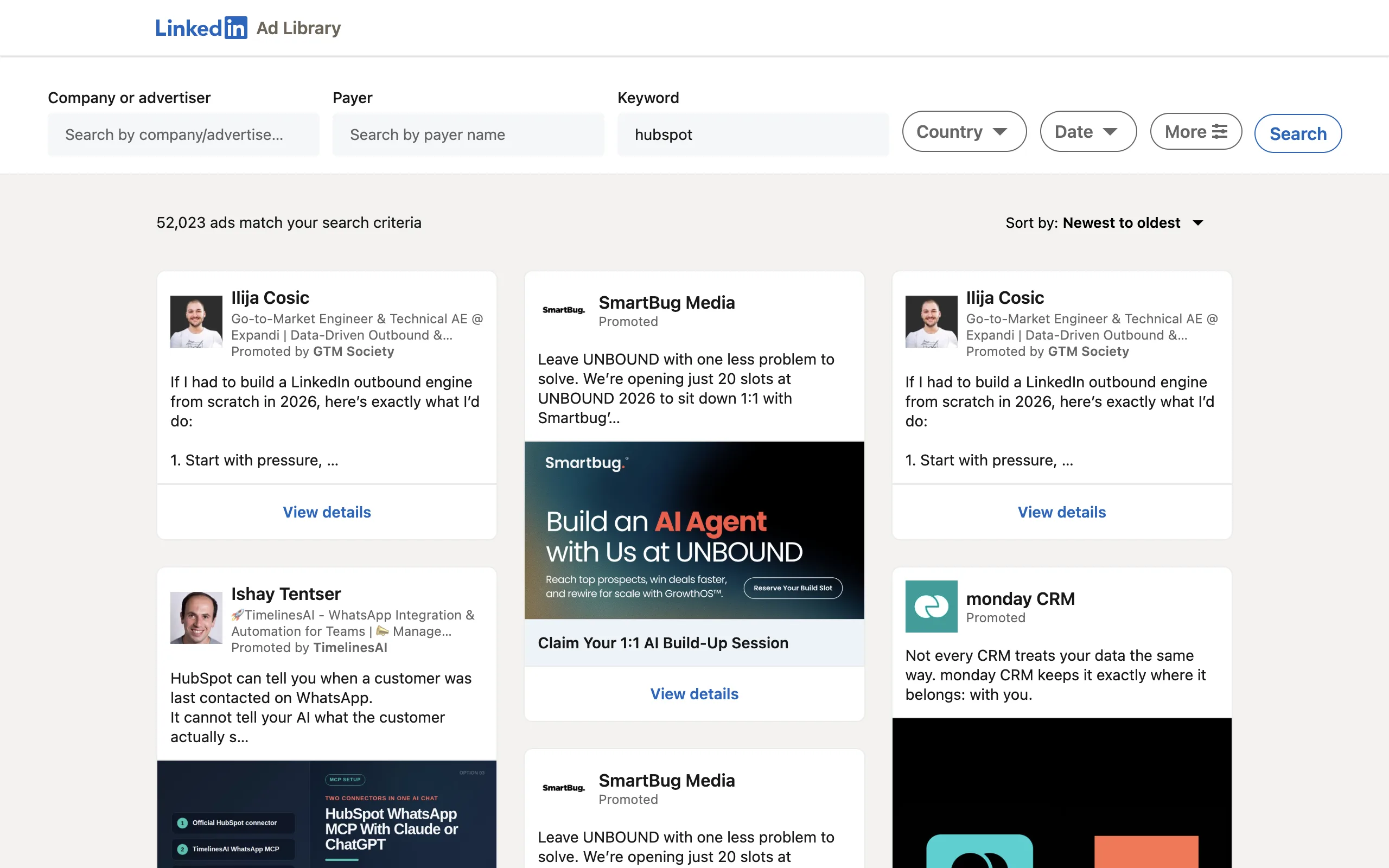
Comparing five competitors means five searches and five sets of screenshots, because nothing here holds state between them.
What it does well
For the job it was built for, it is the best source there is, and no third-party tool can beat it on its own ground. The ads come straight out of LinkedIn's ad serving system, so there is no question of authenticity, no sampling and no lag. An ad is listed because it is serving impressions today.
That immediacy is genuinely valuable, and it is worth saying plainly: no dataset assembled by anyone else, AdPeekly included, can tell you about a campaign that launched an hour ago. If your question is "what is this one company running this week," stop reading and go use the official tool.
Where the LinkedIn Ad Library stops
Ask it a research question instead of a compliance question and it runs out of road quickly. The limits below are not bugs or missing features on a roadmap; they are what a transparency register looks like when you try to use it as a competitive research database.
| What you want | LinkedIn Ad Library | AdPeekly |
|---|---|---|
| Ads from campaigns that already ended | –Deleted | 253,610 published ads kept |
| How long an ad has been running | –Not shown | First and last seen, per ad |
| Searching a whole industry at once | –One advertiser at a time | Filter across all 649 |
| Telling variants apart from real ideas | –Every variant counted | 95,893 distinct creatives |
| Getting the data out | –No export, no API | MCP server, free tier |
It has no memory
When a campaign ends, its ads leave the library. Not archived, not flagged as inactive: gone, with no way to look them up again. And while an ad is live, the library never tells you when it started, so you cannot distinguish a creative launched yesterday from one that has been running since January.
Those two facts together remove the single most useful signal in competitive research. Duration is the closest thing to a public performance metric that exists in advertising: nobody keeps paying, month after month, to serve a creative that does nothing. A tool that deletes ended campaigns and hides start dates is a tool that can show you what is running, but never what worked.
It only answers one company at a time
There is no industry filter, no format filter and no way to ask a question broader than a single advertiser. "Show me what cybersecurity companies are doing" is not a query the library accepts, so scoping a category means listing the companies yourself and searching them one by one.
What you get back is noisier than it looks, too. Advertisers run one creative in many near-identical variants, different headline, cropped image, swapped call to action, and the library lists each variant as its own ad. A single campaign can read as a dozen, so counting ads in the library tells you how much an advertiser is testing, not how many ideas they actually have.
Nothing comes out of it
There is no export, no CSV, no API. Every ad you want to keep for a swipe file or a competitive deck gets screenshotted by hand, and anything programmatic, a dashboard, an alert, a question asked inside an AI assistant, is simply off the table. The data is public to look at and private to use.
What the same ads look like when somebody keeps the history
That history exists, and keeping it is what AdPeekly does. AdPeekly is a research library of B2B LinkedIn advertising: it revisits the same public Ad Library on a repeating schedule, records every ad it finds across a curated list of 649 companies, and keeps each one after LinkedIn drops it, stamped with the first and last date it was seen running. 253,610 published ads later, the questions the section above could not answer have answers. Here are three of them, and what each one is good for.
Most LinkedIn ads are short. A third of them are gone inside a week, and the median ad runs 16 days. The interesting part is the tail: roughly one ad in fifteen is still running after three months, and those are the creatives worth studying, because they are the ones their owners kept paying for. Finding them is a sort, not a search: order the library by observed duration and the survivors come to the top, which is the single most useful thing you can do with a dataset that remembers.
35.0%
Under 7 days
88,664 ads
26.3%
7 to 29 days
66,659 ads
32.0%
30 to 89 days
81,039 ads
6.8%
90 days or more
17,248 ads
How long is normal depends entirely on the industry. Marketing and growth companies keep their median ad live for 42 days, more than two and a half times the dataset median, while AI and cybersecurity advertisers cycle theirs out in about two weeks. Benchmarking a fintech campaign against a dev-tools campaign, which is what a single global average invites you to do, compares two different sports. That is why the industry filter is not a convenience feature: it is what turns a number into a benchmark you can defend in a planning meeting.
| Industry | Published ads | Median duration |
|---|---|---|
| AI & Automation | 31,833 | 13 days |
| Cybersecurity | 29,980 | 14 days |
| HR & Recruiting | 25,819 | 14 days |
| Developer Tools & Infrastructure | 24,481 | 14 days |
| Finance & Fintech | 22,906 | 25 days |
| Sales & Revenue | 20,130 | 18 days |
| Data & Analytics | 14,416 | 15 days |
| Operations & Supply Chain | 11,255 | 21 days |
| Marketing & Growth | 11,146 | 42 days |
| Legal & Compliance | 10,522 | 13 days |
| Productivity & Collaboration | 8,620 | 17 days |
| Consulting & Professional Services | 7,070 | 15 days |
Two thirds of what looks like volume is repetition. Grouping visually matching creatives and keeping one representative of each, those 253,610 ads collapse to 95,893 distinct creatives. Search results and every count on this site use the deduplicated figure, because a gallery of 200 ads that turns out to be 40 ideas in five variants each is the failure mode readers rightly punish. The rule is written out at /methodology#deduplication. For anyone building a swipe file, that rule is the whole point: fifty saved ads should be fifty ideas, not ten ideas saved five times.
One caveat worth stating before you compare these numbers to your own count on LinkedIn: this dataset is a curated list of 649 B2B companies, and only ads that passed review are published. It is deliberately not a live unfiltered mirror of everything LinkedIn holds, so the count for any single company will be smaller than the raw total you could tally by hand. Every published ad has been checked, not just collected.
So what is AdPeekly, exactly?
It is the tool those three findings came out of, built for the people who were doing this research by hand: B2B marketers, founders and agencies who need to know what a category is actually advertising before they write their own brief. Where LinkedIn's Ad Library gives you one advertiser at a time with no past tense, AdPeekly gives you 95,893 distinct creatives from 649 curated B2B companies, every one of them carrying the dates it ran, the format, the industry, the funding stage and the company size.
In practice that means the three moves above are one interface away. Filter to your category and read its real benchmark. Sort by duration and pull out the ads that survived a quarter. Save the deduplicated winners into a board and export the swipe file you would otherwise have screenshotted by hand. And because the same dataset is exposed to AI assistants through AdPeekly's MCP server, you can also just ask the question in Claude or ChatGPT and get the ads back in the conversation.
Every number above came from somewhere. That somewhere is open to you.
Pick the way you prefer to work. Open the web app and go through the library visually, filter by filter, or connect the MCP server and let the assistant you already have open do the searching for you. Same 253,610 ads behind both, and the free tier covers 3 searches a day with no card.
No card for the free tier. Full tool reference at /mcp.
 1Password
 Attio
Attio
 Asana
Asana
 Celonis
 Affinity
 BioRender
 Ashby
Ashby
 Demandbase
 CodeAnt
 Dost
Dost
Frequently asked questions
Yes, by company name, payer name, or free-text keyword, but it has no industry or vertical filter and no way to search across multiple companies at once. Every comparison across advertisers has to be assembled by hand, opening one search after another.
No. LinkedIn does not publish an API for its Ad Library, so nothing can query it programmatically. AdPeekly runs an unofficial, read-only MCP server over its own dataset instead, which any MCP client (Claude, ChatGPT, Cursor) can query directly. See /mcp for how it works and what it returns.
Technically yes, it's a public page, but there's no need to build that yourself: AdPeekly already did the scraping, on a repeating schedule, across 649 curated B2B companies, and structured the result into a searchable dataset with observed campaign durations. That dataset is what the 3-searches-a-day free MCP tier queries. See /mcp.
No. LinkedIn's Ad Library only shows ads currently running; once a campaign ends, it disappears with no historical record. AdPeekly's dataset is the closest thing to an archive: 253,610 published ads, each with a first-seen and last-seen date, so campaign duration is measurable instead of guessed. See the gaps below for what that data actually shows.
Yes, it's free and public, no LinkedIn account needed. AdPeekly's browsing is also free at the MCP tier: 3 searches a day, up to 5 ads each, no card required. It's the same underlying data, indexed for cross-company search instead of one advertiser at a time.
See what LinkedIn's Ad Library can't show you
253,610 published ads, 95,893 distinct creatives, searchable by industry, format and how long each one actually ran.
See pricingData verified September 22, 2026. How it is collected: methodology.